Your brain is filtering reality right now. Every second, roughly eleven million bits of sensory data flood your nervous system, and your conscious mind processes fewer than fifty. The gatekeeper deciding what gets through? A small bundle of neurons in your brainstem called the Reticular Activating System (RAS).
This is the mechanism behind the "new car effect." You decide you want a red SUV, and suddenly you see them on every highway. The world didn't change. Your filter did.
A vision board is the most powerful tool you have for programming that filter on purpose.
But here's the problem: most vision boards fail. They get made in January, admired for a week, and forgotten by March. The images are generic. The goals are vague. The board itself lives in a drawer — or worse, exists only as a digital file buried in a phone.
This guide is different. We're going to walk you through everything: the neuroscience of why vision boards work, the step-by-step process of building one that activates your brain, and the one decision that separates people who manifest their goals from people who just daydream about them.
That decision? Whether your vision board is something you scroll past — or something you see every single day, hanging in your space, demanding your attention.
Let's begin.
What Is a Vision Board?
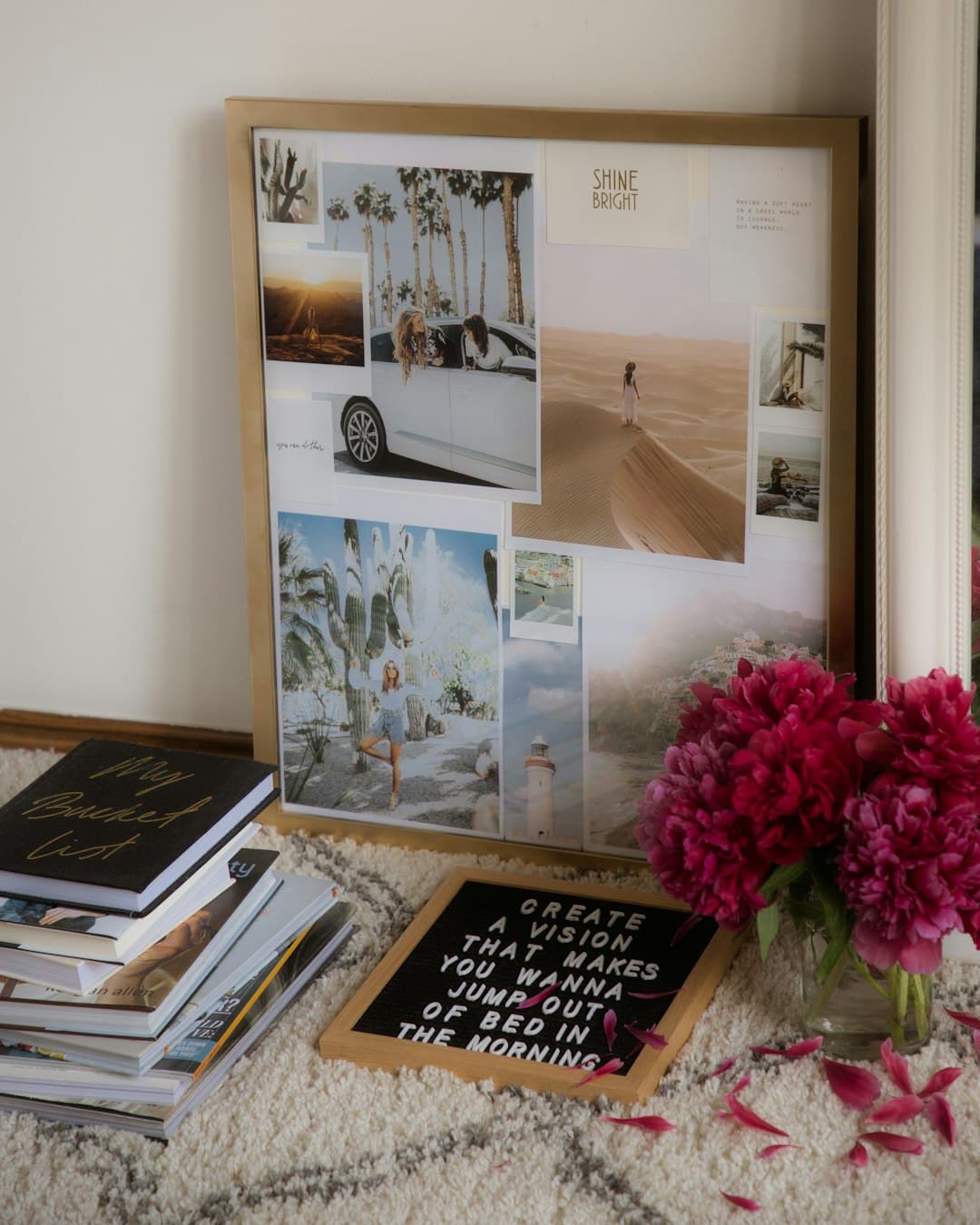
A vision board is a curated visual display of your goals, desires, and intentions. It combines images, words, and symbols that represent the life you're working toward — arranged in a way that creates an emotional response every time you look at it.
Think of it as a contract between your conscious mind and your subconscious. Your conscious mind chooses the images. Your subconscious absorbs them. Over time, through repeated exposure, your brain begins treating those images as a preview of your reality rather than a fantasy.
Vision boards have roots in ancient visualization practices. Warriors, monks, and mystics across cultures have used focused imagery to prepare for battle, deepen meditation, and attract abundance. What's changed is that neuroscience can now explain why these practices work — and that explanation makes a compelling case for doing it more deliberately than ever.
The Neuroscience: Why Vision Boards Work
Your Brain's Attention Filter: The Reticular Activating System
The RAS is a network of neurons in your brainstem responsible for attention, arousal, and focus. Its primary job is deciding what sensory information reaches your conscious awareness and what gets filtered out.
When you create a vision board and view it daily, you're sending your RAS a set of instructions: This matters. Watch for this. Prioritize this. Over time, your brain begins highlighting opportunities, resources, and connections that align with the images on your board — things you might have walked past a hundred times without noticing.
This isn't magical thinking. It's the same mechanism that makes you notice a song lyric after a breakup, or spot "For Sale" signs after you start thinking about buying a house. Your RAS responds to what you focus on. A vision board gives it something specific to focus on.
Neuroplasticity: Rewiring Your Brain Through Repetition
Your brain physically changes in response to repeated thought patterns. This is neuroplasticity — the ability to form new neural connections throughout your life.
When you visualize your goals and the feelings associated with achieving them, you encourage your brain to build and strengthen the pathways connected to those outcomes. The research is striking: studies in motor imagery have shown that mentally rehearsing an activity activates many of the same neural circuits as physically performing it. Athletes have used this principle for decades. A basketball player who visualizes free throws improves nearly as much as one who practices them physically.
Every time you look at your vision board, you're running a mental rehearsal. You're not just hoping — you're training your brain to recognize and pursue the reality you've chosen.
Dopamine and Emotional Encoding
Your brain processes visual information dramatically faster than text. When you see an image that represents a deeply held goal, your brain releases dopamine — the neurotransmitter associated with motivation and reward-seeking behavior.
This is why the images on your vision board matter so much. Generic stock photos of luxury cars or beach sunsets might look nice, but they don't trigger the same neurological response as an image that feels personal, specific, and emotionally resonant. The best vision board images make you feel something: excitement, longing, certainty, determination.
That emotional charge is what locks the image into your subconscious and tells your RAS to take it seriously.
Why Physical Vision Boards Are Superior to Digital Ones
This is the part most guides skip. And it's the part that matters most.
In a world of digital tools, apps, and Pinterest boards, it's tempting to make your vision board on a screen. It's faster. It's easier. And it's significantly less effective.
Here's why.
The Viewing Time Problem
A vision board works through repeated, sustained visual exposure. The more often you see it — and the more deeply you engage with it — the stronger the neurological impact.
A digital vision board lives on your phone, competing with notifications, social media, and the relentless scroll. It's one of thousands of images your eyes pass over in a day. Your brain treats it the same way it treats an ad: it registers and dismisses it in fractions of a second.
A physical board, mounted on your wall, occupies real space in your environment. You see it when you wake up. You see it when you walk past your desk. You see it when you sit down to plan your week. There's no scrolling past it. There's no swiping away. It's present, persistent, and impossible to ignore.
Research on what neuroscientist Dr. Tara Swart calls "value tagging" supports this: the brain assigns higher importance to images it encounters repeatedly. The more exposure, the stronger the priming effect. A physical board in a high-traffic area of your home delivers dozens of touchpoints per day — without you needing to open an app or remember to look.
The Power of Seeing Yourself in Your Future
Here's a question: when you look at a stock photo of a stranger standing on a mountaintop, does your brain believe that's your future? Not really. Your subconscious knows the difference between someone else's life and yours.
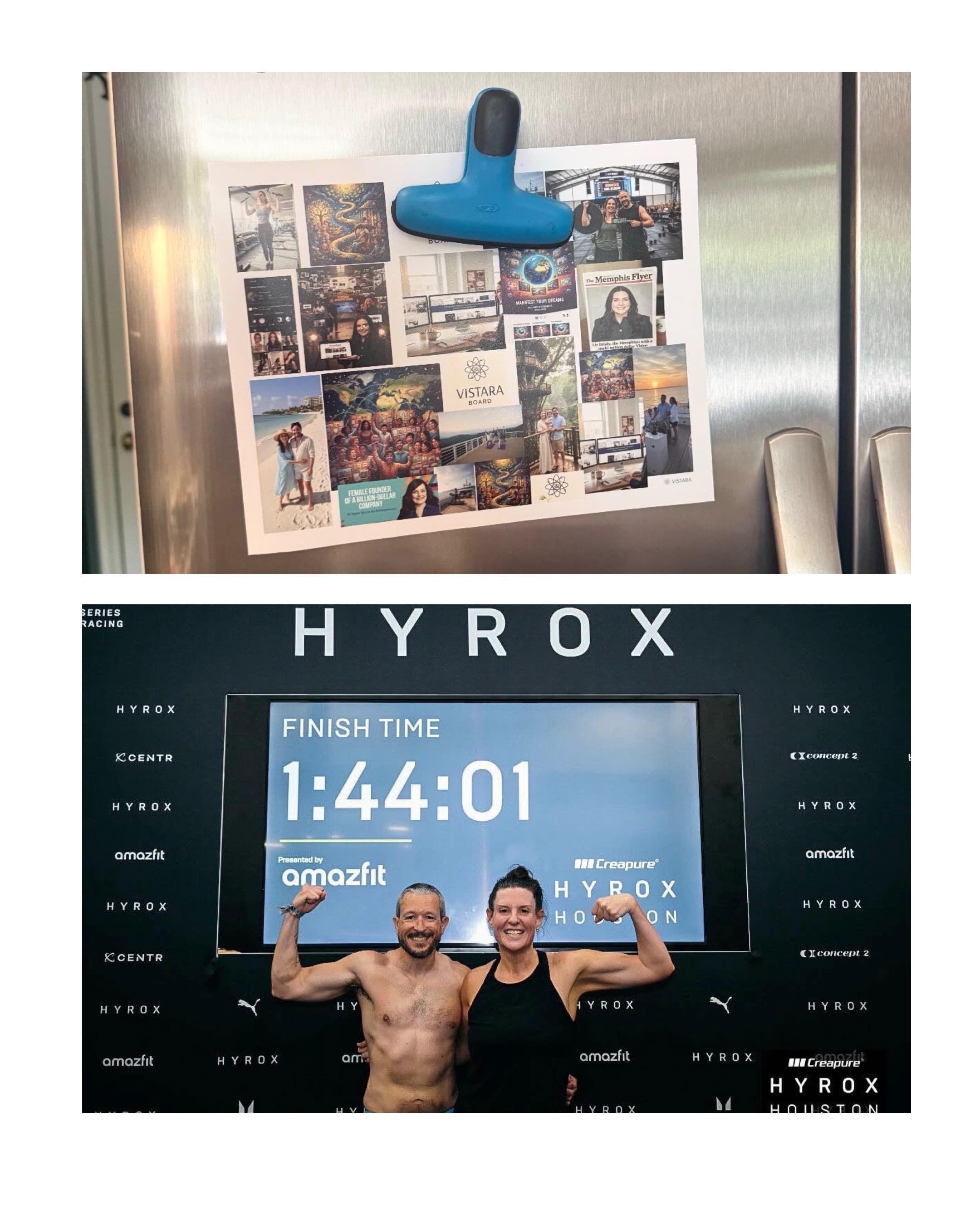
Now imagine looking at a photo-realistic image of you — wearing the lab coat after earning your medical degree. Crossing the marathon finish line with the medal around your neck. Standing at the podium of the company you built. When your brain sees your own face living the life you're designing, something profound happens: the gap between "fantasy" and "upcoming reality" shrinks. Your RAS doesn't file it under "nice dream." It files it under "this is where we're headed."
This is one of the most psychologically powerful advantages of a modern vision board experience. Custom image creation tools can now generate realistic scenes of you having already achieved your goals — and when those images live on a physical board you see every morning, the combined effect of personal imagery and daily physical exposure is extraordinary.
A few tips for getting the most out of custom-generated images:
For relationship goals: If you want to manifest a loving partnership but don't have strong preferences about what your future partner looks like, try a different approach. Instead of generating an image of you standing next to a stranger's face, pick a scene from a movie that you find powerfully romantic — a couple dancing in the rain, a candlelit dinner, a quiet moment on a balcony at sunset. That cinematic scene will evoke the feeling of being deeply in love far more effectively than a portrait of you beside someone you've never met.
For family and togetherness goals: If generated faces feel slightly off — that occasional "uncanny valley" quality — there's an elegant workaround. Have the image show you and your family from behind: walking hand-in-hand down Main Street at Disney World, waving from the deck of a beach house, strolling through a park with a stroller. Your brain will register the scene as "me and mine" without getting tripped up by facial details. It's a small creative choice that makes a big psychological difference.
The Commitment Signal
Ordering or creating a physical vision board is an act of commitment. It tells your subconscious, This isn't casual. I'm investing in this. This is real. That psychological commitment amplifies the board's effectiveness because your brain begins treating the goals on it as plans rather than wishes.
How to Make a Vision Board: Step by Step
Step 1: Get Clear on What You Actually Want
This is where most people rush — and where the most important work happens.
Before you touch a single image, sit with these questions:
- What does my ideal life look like one year from now?
- What does it look like five years from now?
- In what areas am I most hungry for change: career, relationships, health, finances, personal growth, spirituality?
- What would I pursue if I knew I couldn't fail?
- How do I want to feel every day?
Write your answers down. Be specific. "Financial freedom" is a start, but "earning $200,000 a year from work that energizes me" is a direction your RAS can actually work with.
This reflection phase is the foundation. Skip it, and your board becomes a pretty collage. Do it well, and your board becomes a blueprint.
Step 2: Choose Your Board Type
Full Life Vision Board: This covers every major area — career, health, relationships, finances, spirituality, personal growth, travel, family. It gives you the panoramic view of your ideal life. Best for people who want a comprehensive reset or who are at a major transition point.
Single Goal Vision Board: This focuses all your visual energy on one objective. Launching a business. Training for a marathon. Finding a partner. Recovering from a difficult chapter. The concentrated focus can be extraordinarily powerful when you have one clear priority.
You can have both. Many people create a full life board for their office and a goal-specific board for their bedroom or workspace.
Step 3: Gather Your Images
This is where your board comes alive. You're looking for images that trigger an emotional response — not just ones that look good.
Sources for vision board images:
Your own photos: Images of you doing the things you want to do more of. Photos from your happiest moments. Pictures of places you've been and want to return to. Personal images create the strongest neurological connection because your brain recognizes you in the scene.
Curated image libraries: High-quality, emotionally resonant images of goals, lifestyles, and experiences you're working toward. The quality of the image matters — blurry magazine clippings or low-resolution screenshots undermine the emotional impact.
Custom-generated images: As we covered above, this is the most psychologically powerful option available today. Tools like Vistara Board's custom image creator let you generate photo-realistic scenes of yourself having already achieved your goals. See the tips above for making these images as emotionally effective as possible — especially for relationship and family goals.
Words and affirmations: Short, powerful statements that reinforce your vision. "I am building something that matters." "My health is my wealth." "I attract abundance through alignment." Place them alongside your images for a dual visual-verbal impact.
What to avoid:
- Generic motivational posters that don't connect to a specific goal
- Images of other people's lives that make you feel envy rather than inspiration
- Cluttering the board with too many images (aim for 10–20 powerful ones rather than 50 forgettable ones)
Step 4: Arrange and Build
Whether you're working with a digital builder or physical materials, arrangement matters. Group images by life area or goal. Place the most important images in the center, where your eye naturally falls first.
Leave breathing room. A cluttered board creates visual noise and dilutes focus — the opposite of what your RAS needs. Think of your board as a curated gallery, not a scrapbook explosion.
Step 5: Display It Where You'll See It Every Day
This step determines whether your vision board works or collects dust.
The ideal placement is somewhere you spend time daily and where you can pause and look — not just glance:
- Across from your bed, so it's the first and last thing you see
- Above your desk or workspace
- In your meditation or journaling corner
- On a wall you pass multiple times a day
If your board is digital-only, set it as your phone wallpaper and your desktop background. But understand that this is a compromise, not an optimization. The physical board remains the gold standard for sustained neurological activation.
Step 6: Engage With It Daily
Don't just look at your board. Use it.
Spend two to five minutes each morning standing in front of your board. Let your eyes move across each image. Let yourself feel the emotions each image represents. Visualize yourself inside those images — not as a spectator, but as the person living that moment.
This daily practice transforms your vision board from decoration into a neurological training tool. It's the difference between owning a gym membership and actually working out.
Vision Boards for Specific Goals and Life Stages
Vision Boards for Executives and Leaders
Your vision board isn't just about personal goals — it's about the leader you're becoming. Include images that represent your leadership identity: the team you're building, the impact you're creating, the legacy you're designing. High-performers use vision boards to stay connected to why they do the work, not just what the work is.
Vision Boards for Athletes
Athletes already understand visualization. A vision board makes it tangible and persistent. Include images of the performance you're training for, the body you're building, and the feeling of crossing that finish line. Personal photos — you at your strongest — are more effective than images of professional athletes.
Vision Boards for Entrepreneurs
Entrepreneurship is a long game, and motivation fades when the results haven't arrived yet. A vision board keeps your RAS locked onto the outcome during the difficult middle. Include images of the business you're building, the customers you're serving, and the life your business makes possible.
Vision Boards for Women Seeking Love
A vision board for relationships works best when it focuses on how you want to feel in partnership rather than the specific person you want to attract. Images of connection, intimacy, adventure, laughter, and shared purpose speak to your subconscious more powerfully than a checklist of physical traits.
Vision Boards for Women Seeking Motherhood
This is one of the most emotionally powerful uses of a vision board. Images of nurseries, first moments, family rituals, and the version of yourself as a mother can create a deep alignment between your desires and your daily actions. Many women find this practice grounding and centering during a journey that can feel uncertain.
Vision Boards for Students
You're standing at the beginning of everything. A vision board helps you define what "everything" looks like before the noise of adulthood starts making those decisions for you. Include your career aspirations, the experiences you want, the person you're becoming, and the impact you want to have.
Vision Boards for People in Recovery
Recovery is the ultimate act of reimagining your future. A vision board can serve as a daily reminder of the life you're building — not the one you're leaving behind. Focus on health, connection, purpose, and freedom. The board becomes evidence that your future is brighter than your past.
Vision Boards for Spiritual Seekers
If you're drawn to manifestation, the law of attraction, or the teachings of thinkers like Eckhart Tolle, Abraham Hicks, Bob Proctor, or Wallace Wattles, a vision board is the physical bridge between intention and reality. It's where ancient wisdom meets modern neuroscience — the practice of focused intention backed by the science of neuroplasticity and RAS activation.
Common Vision Board Mistakes (and How to Avoid Them)
Mistake 1: Making it once and forgetting it. Your vision board should be a living tool, not a January art project. Review it monthly. Update it quarterly. Remove goals you've achieved and add new ones.
Mistake 2: Using only outcome images. Research by Gabriele Oettingen at NYU suggests that visualizing only the desired outcome can actually reduce motivation by creating premature satisfaction. Balance outcome images (the result) with process images (you doing the work). Include both the finish line and the training run.
Mistake 3: Cramming too many goals onto one board. Your RAS needs clarity, not clutter. If you have goals across many life areas, consider multiple focused boards rather than one overloaded one.
Mistake 4: Keeping it digital only. We covered this above, but it bears repeating. A digital board is better than no board. A physical board is better than a digital one. The science of repeated visual exposure, multi-sensory engagement, and environmental priming all favor the physical format.
Mistake 5: Choosing images that look good instead of images that feel right. Your board isn't for Instagram. It's for your subconscious. Choose images that make you feel something, even if they aren't aesthetically perfect.
The Guided Vision Board: A Better Way to Build
Most vision board tools give you a blank canvas and wish you luck. That approach works for people who already have crystal clarity on their goals — but for everyone else, staring at a blank board can feel paralyzing.
A guided vision board experience changes the equation entirely. Instead of starting from zero, you work through a structured process that helps you:
- Identify what you actually want through reflective prompts and exercises — not just what you think you should want
- Clarify your goals across every life area with a structured course that builds clarity before you ever touch an image
- Select images with intention from curated libraries, personal uploads, and custom image creation tools that can generate images of you in your desired future
- Arrange your board with guided layouts designed for maximum visual impact and neurological effectiveness
- Receive your finished board as a physical product — printed, shipped, and ready to hang on your wall
This is the approach that Vistara Board was built around. It's the world's only guided vision board builder that combines a multi-module clarity course, a drag-and-drop board builder with over 20,000 curated images and custom image creation, and professional printing and shipping — so the board you design arrives at your door, ready to transform your daily environment.
The Vistara Board approach is built on a simple framework: Science ✶ Intention ✶ Alignment. The science of how your brain responds to visual stimuli. The intention of getting clear on what you want before you start designing. And the alignment between your inner vision and the physical board that makes it real.
How to Use Your Vision Board for Maximum Impact
The Morning Ritual
Stand in front of your board for two to five minutes each morning. Take three deep breaths. Let your eyes rest on each image. For each one, feel the emotion of having achieved that goal — not hoping for it, but experiencing it as if it's already happening. This primes your RAS for the day and sets your brain's filter to "seek mode."
The Weekly Check-In
Once a week, sit with your board and ask: What step did I take this week toward any of these goals? What step will I take next week? This connects your vision to action — the critical link between manifestation and results.
The Quarterly Update
Every three months, review your board. Celebrate what you've achieved. Remove goals that no longer resonate. Add new ones that reflect your growth. Your board should evolve as you do.
The Bottom Line
A vision board isn't a wish list. It's a neurological tool backed by decades of research in visualization, neuroplasticity, and attention science. When done right — with clarity, intention, emotional resonance, and daily physical visibility — it reprograms your brain's attention filter to notice and pursue the opportunities that align with your deepest goals.
The most important decision you'll make isn't which images to include. It's whether your board lives on a screen you scroll past — or on a wall you can't ignore.
Your future is asking to be seen. Give it a place to live.
Ready to build a vision board that actually works? Vistara Board is the world's only guided vision board builder that ships a finished, physical board to your door. Start with the free Clarity Course preview and see what's possible when science meets intention.
Related Reading:
- Vision Boards for Athletes: How Elite Performers Use Visualization (coming soon)
- The Science of Manifestation: What Neuroscience Says About the Law of Attraction (coming soon)
- AI Vision Board Maker: How Custom Image Generation Creates Deeper Emotional Resonance (coming soon)
- Vision Board Printing: Why the Physical Board Is the Competitive Edge (coming soon)
© Vistara Board. All rights reserved.