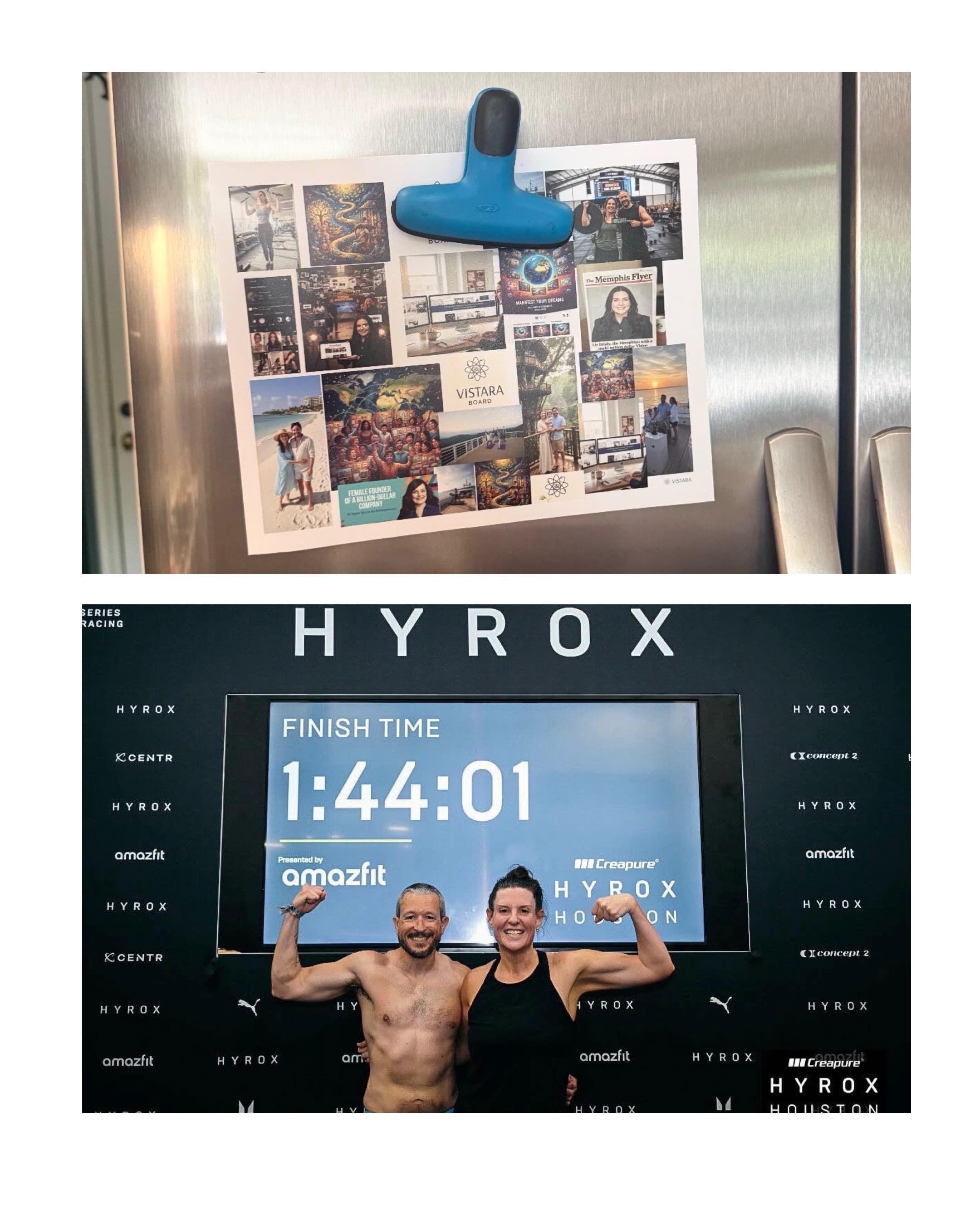
The science says a physical board works better. But "physical" doesn't have to mean magazine clippings on cardboard.
If you've read anything about vision boards and neuroscience, you already know the punch line: a physical board outperforms a digital one. The Reticular Activating System responds to repeated visual exposure in your environment. A board on your wall delivers dozens of passive impressions per day. A JPEG on your phone competes with notifications and gets swiped past in half a second.
So the case for printing your vision board is strong. The question is how you print it, and whether the finished product is something you'll actually be proud to display in your home, your office, or your bedroom.
Because here's the part that most guides leave out: if your physical vision board looks like a craft project, you're less likely to put it somewhere prominent. And if it's not somewhere prominent, you lose the entire neurological advantage of having a physical board in the first place.
The format matters. The quality matters. And the difference between a board you tolerate on your wall and a board you're drawn to look at is the difference between a decoration and a tool that's actively working on your brain.
The Current Landscape: Your Options for a Physical Vision Board
Let's walk through what's actually available right now if you want a physical vision board, because the options are more limited than you'd expect.
Option 1: The DIY Magazine Board
This is the classic. Buy a poster board from the craft store, flip through magazines, cut out images, glue them down. It's the vision board your mom might have made at a New Year's party with friends.
There's nothing wrong with the ritual of it. Sitting down with magazines and scissors can be meditative and fun. But the finished product has real limitations. The images are constrained to whatever magazines you have on hand. The quality is uneven, with some images crisp and others torn or blurry. The board itself is flimsy poster board or cork that warps, bends, and deteriorates over time. And the aesthetic? It reads as "arts and crafts." Which is fine for the process, but less ideal for something you want to display in your living room for an entire year.
Most importantly, none of the images are you. They're strangers living lives that your subconscious knows aren't yours.
Option 2: Design It Digitally, Print It Yourself
This is the Canva approach. You use an online design tool to arrange stock photos on a template, download the file as a PDF or JPEG, and then figure out how to get it printed. Maybe you take it to Staples or FedEx. Maybe you order a poster print from an online service.
The design quality improves over the DIY approach, but you're still working with generic stock photos, and the printing logistics fall entirely on you. You'll need to find the right paper size, the right print quality, the right printer. Then you'll need to figure out how to mount or frame it yourself. The gap between "finished my design on Canva" and "beautiful board hanging on my wall" is wider than most people expect, and many vision boards die in that gap.
Option 3: Online Poster Printing Services
A few companies have started offering vision board printing. You upload images into a template, and they ship you a printed poster. This is a step forward because it eliminates the trip to Staples and gives you a purpose-built template.
But the product that arrives is still a poster. Printed on matte poster paper, shipped rolled in a tube, unframed. You unroll it, find something to stick it to the wall with, and hope the edges don't curl. It can look good, but it has the aesthetic lifespan of a college dorm poster. Over time, the corners bend. The surface scuffs. It never quite looks like something intentional hanging in your home.
For a tool that's supposed to live on your wall for a year or more, delivering daily neurological impact, the format feels temporary.
Option 4: A Framed, Professionally Printed Vision Board
This is the category that barely exists yet, and it's the one that makes the most sense.
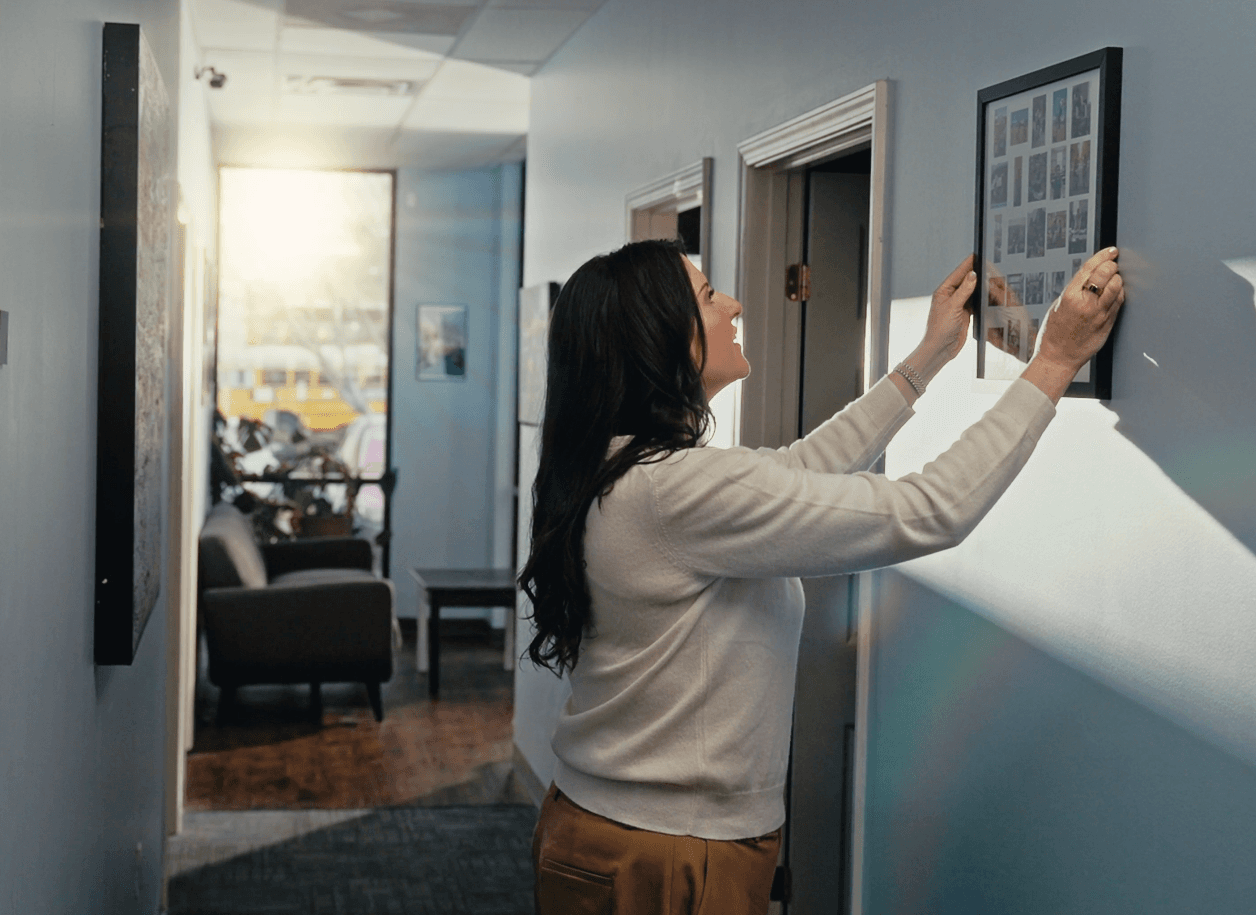
Think about what actually earns permanent wall space in your home. Framed photographs. Framed art. Things that look intentional, polished, and personal. A framed vision board occupies that same category. It doesn't look like a project. It looks like something that belongs there.
A wood-framed vision board printed on premium materials arrives ready to hang. No trip to the frame shop. No Command strips holding up curling corners. No visual compromise between "this is important to me" and "this looks good in my space."
The permanence also sends a signal to your subconscious. A poster feels disposable, something you might take down when you get tired of it. A framed board feels like a commitment. And that commitment reinforces the seriousness of the goals it represents.
Why Print Quality Matters More Than You Think
The neuroscience of vision boards depends on emotional response. Every time you look at your board, the images need to trigger something: motivation, excitement, longing, determination, gratitude. If the images are blurry, poorly printed, or washed out, the emotional response weakens. Your brain processes the board as low-priority visual information rather than something worth paying attention to.
High-resolution printing on quality materials preserves the vibrancy and detail that make images emotionally engaging. This is especially true for AI-generated custom images, like a photo-realistic scene of you crossing a finish line or standing in front of your dream home. Those images were created with specific detail and emotional intent. Printing them on cheap paper with a consumer inkjet printer doesn't do them justice.
The investment in print quality is really an investment in the board's effectiveness. A beautiful, vivid, well-printed board earns more of your attention. More attention means more RAS activation. More activation means the board is doing its job.
Vision Board Printing: What to Look For
If you're evaluating how to get your vision board printed, here are the factors that matter most:
Print resolution and paper quality. Look for archival-quality or premium luster paper. Matte finishes reduce glare, which matters if your board is near a window or in a well-lit room. The print should be sharp enough that you can stand close and still see detail in every image.
Size options. Your board needs to be large enough to see clearly from a few feet away but proportional to the wall space you have. Common sizes range from 11x14 inches (good for a desk or smaller room) to 18x24 inches (a strong presence on a bedroom or office wall) to 16x20 inches (the sweet spot for framed display).
Framing. This is the biggest differentiator. An unframed poster and a wood-framed print are fundamentally different products in terms of durability, aesthetics, and the psychological weight they carry. If you can get your board framed as part of the printing process rather than as a separate DIY step, do it. The friction of "I'll frame it later" is where many vision boards end up in a closet.
Shipping and handling. A poster shipped rolled in a tube arrives with curl and potential creasing. A framed board shipped flat and protected arrives ready to hang. The unboxing experience might sound like a small detail, but it's actually the first impression your board makes on you, and first impressions set the tone for how seriously you take the tool.
Integration with the design process. The ideal scenario is a platform where you design your board and print it in the same place, with no file exports, no separate print orders, no "save as PDF and then figure out the rest." The fewer steps between finishing your design and holding your board, the more likely you are to actually follow through.
The Vistara Board Approach to Vision Board Printing
This is the problem Vistara Board was designed to solve from day one: the gap between creating a vision board and having a physical product that's worthy of permanent display in your home.
The Vistara Board process is end-to-end. You work through a 16-module Clarity Course to get clear on your goals. You design your board using a drag-and-drop builder with access to over 20,000 curated images, personal photo uploads, and custom AI image generation that creates photo-realistic scenes of you in your desired future. And when your design is complete, your board is printed on premium materials and shipped directly to your door.
The Founders' Vision package (starting at $17/month) includes an 11" × 14" wood-framed vision board along with an 8" × 10" companion print—perfect for your office, bedroom, or even your refrigerator. It also includes free shipping, and everything arrives ready to hang.
The Achiever's Edge package (starting at $16/month) features a larger 16" × 20" wood-framed vision board, the 8" × 10" companion print, and a hardcover Gratitude & Goals Journal. Like the Founders' Vision package, it includes free shipping and arrives ready to hang.
The Vision in Hand package starts at $19/month and includes an 18" × 24" premium luster poster. It's a great choice if you'd like to select your own frame or display your vision board in a larger format.
The point isn't just that the printing is included. It's that the entire experience, from goal clarity to image selection to board design to physical production, happens in one place. You never leave the site. You never export a file to a separate print service. You never make a trip to a frame shop. The board you design is the board that shows up at your door, framed and ready to change your daily environment.
A Note on Secondary Boards
One detail worth mentioning: both the Founders' Vision and Achiever's Edge packages include a secondary 8x10" print alongside the main framed board. This is a deliberate design choice based on the neuroscience of vision board placement.
The ideal setup is two boards: one for intentional daily engagement (your office, your bedroom, wherever you do your morning practice) and one for passive exposure throughout the day (the kitchen, a hallway, a bathroom mirror area). The framed board serves the first purpose. The secondary print, small enough to hang with a magnet on the fridge or prop on a shelf, serves the second.
Two touchpoints. Two kinds of engagement. One vision. If you've read our guide to vision board placement, you know this combination of intentional and passive viewing is what drives the deepest neurological results.
The Bottom Line on Vision Board Printing
A physical vision board is more effective than a digital one. The research on repeated visual exposure, RAS activation, and environmental priming all point in the same direction. But "physical" covers a wide range, from a poster board covered in magazine clippings to a wood-framed, gallery-quality print that earns its place on your wall.
The format you choose determines two things: how long the board lasts and how prominently you display it. Both of those directly affect how much neurological work the board does over the course of a year.
If your vision board is going to live in your home, in your line of sight, working on your subconscious every single day, it should look like something that belongs there. Not something you're hiding when guests come over. Not something curling at the corners. Something you're proud of. Something permanent. Something that tells your brain, every time your eyes land on it, that these goals are real and they are yours.
That's the board worth printing.
Ready to build and print a vision board you'll actually display? Vistara Board is the only platform where you design your board and receive a premium framed product shipped to your door, all in one place. Start with the free Clarity Course preview.
Related Reading:
- The Ultimate Guide to Vision Boards: How to Make a Vision Board That Actually Works
- AI Vision Board: How Custom Image Generation Creates a Board Your Brain Actually Believes
- Why Your Vision Board Gets More Powerful Over Time
- The Science of Manifestation: What Neuroscience Says About the Law of Attraction (coming soon)
© Vistara Board. All rights reserved.